
Elevator version for the attention challenged:
1 Your lower back is too tight (probably from sitting too much) and the nerves don’t work right and lose a bit of control of the hip muscles.
2 This causes damage and scar tissue and then it clicks when you exercise.
3 A chiropractor fixes it by adjusting your spine and hip, improving the nerve function, and maybe using ART on the hip capsule and muscles to fix the click.
4 Get a stretch pdf by emailing me at gary@unavita.ca and asking nicely.
Should You Worry?
The clicking noise you sometimes hear in your hip is extremely common and not usually a medical concern (like osteoarthritis). However, I am not medical doctor, I am chiropractor. My job is to be concerned before it becomes a medical concern. In most cases the click is a sign of misalignment, dysfunction and mild damage (scar tissue) in and around the hip capsule. Let’s talk about it.
Isn’t It Called “Snapping Hip?”
Yes. I think “Snapping hip” sounds too scary, like a bone is breaking, so I usually refer to it as “clicking hip.”
Ball and Socket Joints are Fussy
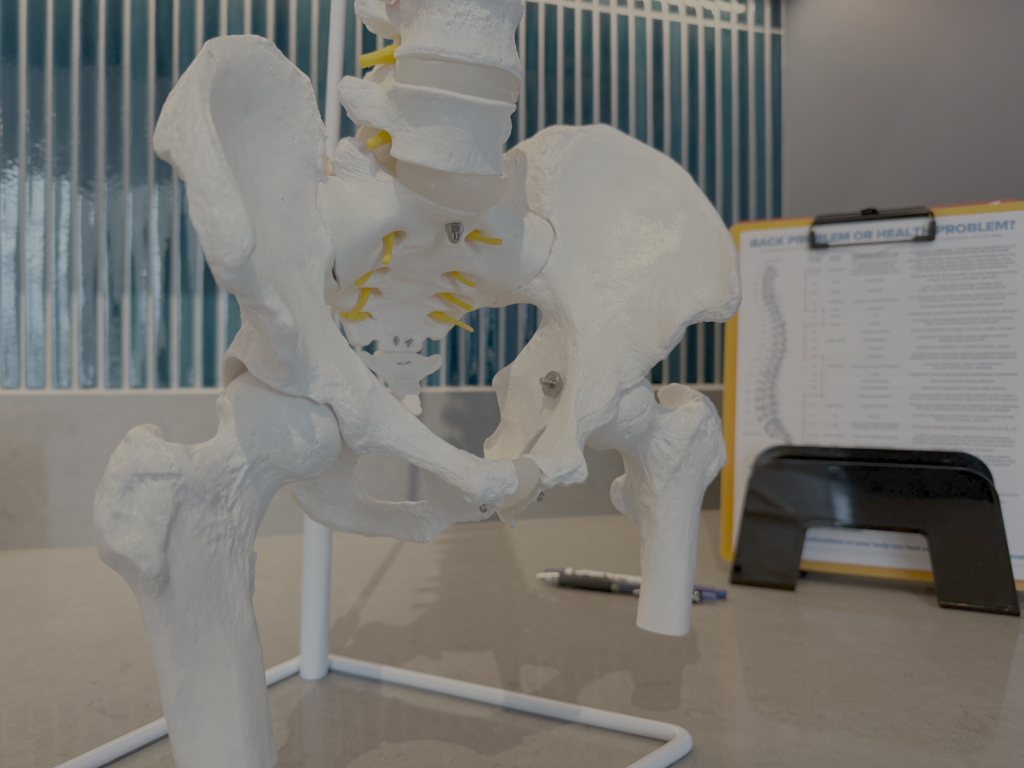
Ball and socket joints require precise coordination to move properly. They are capable of moving in all directions, but will only move in one direction at a time. This means that multiple stabilizing muscles have to hold the joint in precise alignment while moving.
For this to stay 100% you need, among other things, coordination and integrity of the muscles. Coordination occurs when your brain and nervous system practice an activity frequently enough to gain and maintain strength and ability. Ergo, you need a 100% functioning nervous system to have 100% coordination.
If this joint is just a little out of place due to decreased coordination, the joint won’t track properly and you will be susceptible to dysfunction.
How Does This Mild Hip Damage Occur
When we are talking about milder dysfunction-related causes of hip clicking, this mild damage occurs either from hard work or from not enough oxygen (or a combination of both). This problem is extremely common because many of us are active in the gym or sports, but sit at a desk and drive for much of the day. This is a perfect recipe for clicking in the hip.
Why Adjustments?
Chiropractors can adjust the hip joint itself to create smooth motion. However, if the pelvis and lower back (and knees and feet for that matter) are not aligned, then the hip will continue to be under more stress.
The main reason for misalignment in the hips and pelvis is spinal subluxation. Your spine houses the nerves that carry the signal from your brain to realign all parts of your body. If that nerve signal is disrupted due to stiff and crooked spinal segments, your hips and pelvis will be in poor alignment and your hip movement will lose coordination.
Spinal adjustments are the key treatment chiropractors use to correct spinal subluxations and improve the coordination and function of your body.
When Should I Address Hip Clicking
The sooner you ask your chiropractor to address the clicking in your hip, the easier it will be to correct it and your spinal subluxations.
The trouble is that the damage after many sedentary years can go unnoticed until you do that new exercise class. So although the click is new, the damage causing the click can be quite old.
Should I keep Exercising?
You should get the problem checked by a chiropractor so they can screen you for medical issues and start fixing the problem. They may even take X-rays if appropriate to look for arthritis or spinal degeneration that can be present without your knowledge.
What About Stretches?
The muscles that usually click are in the font of the hip capsule. The TIME technique I developed is perfect for isolating the muscles and stretching them so you can minimize the likelihood of clicking in your hip.
You can get the stretch in one of two ways. You can email me at gary@unavita.ca and ask for it. I will send you a pdf copy of the stretches for the correct muscles, as well as an intro to my book “Time To Stretch” which is available on Kindle and Apple Books (in Ebook format). The second way, is to purchase the book.
What Nerves Control the Hip Muscles?
What a great question? I am really surprised by what a smart question that is! Good job! The hip musclesare supplied by the nerve roots coming out of the spine from L2 to S1 (in your lower back). When your spine stops moving, these nerve roots can be irritated, misfire and send rapid electrical signals to the muscles. This places the muscles into involuntary tension (guarding or spasms).
Can Adjustments Help my Muscles?
Yes. When a spinal segment moves poorly or lacks stability, muscles undergo protective spasm. Over time this causes chronic muscle fatigue and failure, not only around the spine, but in the nerve roots exiting the spine going to all the muscles all the way down to the hips and legs.
Adjustments are performed in series, in a treatment plan, to help restore normal movement and nerve function so your muscles stop spasming and behave optimally again.